Growing Agripreneurs and Ecosystems: What happens after the training ends?
Since 2018, the Agripreneurship Alliance has worked with universities, trainers, entrepreneurs and partner organisations across Africa to strengthen the skills, confidence and practical capabilities needed to build sustainable agribusinesses.But numbers trained tell only part of the story.The more important questions are what happens afterwards. Do participants continue to use what they have learned? Do businesses start and grow? Are jobs created? Do trainers continue to teach? Does entrepreneurship education become embedded within universities and other institutions? And does the knowledge gained by one person eventually reach others?
In summer 2026, we asked Anas Serraj, an economics graduate from Mohammed VI Polytechnic University (UM6P) Faculty of Governance, Economics and Social Sciences in Morocco, to help us answer those questions through the Agripreneurship Alliance's first multidimensional assessment of our longer-term impact.Anas undertook the research during a one-month internship with the Alliance in Switzerland, bringing previous applied research experience from Morocco's Haut-Commissariat au Plan and CNR-IRCrES in Italy, as well as earlier experience with the Food and Agriculture Organization of the United Nations.
We are enormously grateful to Anas for the energy, curiosity and independence he brought to this research, and wish him every success as he continues his postgraduate studies in economics at Maastricht University.
Looking beyond participation
Growing Agripreneurs and Ecosystems examines the contribution made by the Alliance's entrepreneurship and Training of Trainers programmes between 2018 and 2026.Rather than attempting to attribute every subsequent success to a training programme, the research deliberately takes a contribution-based approach. Entrepreneurship does not happen in isolation. Access to finance and markets, economic conditions, individual motivation, networks, infrastructure and many other factors influence whether an entrepreneur ultimately succeeds.
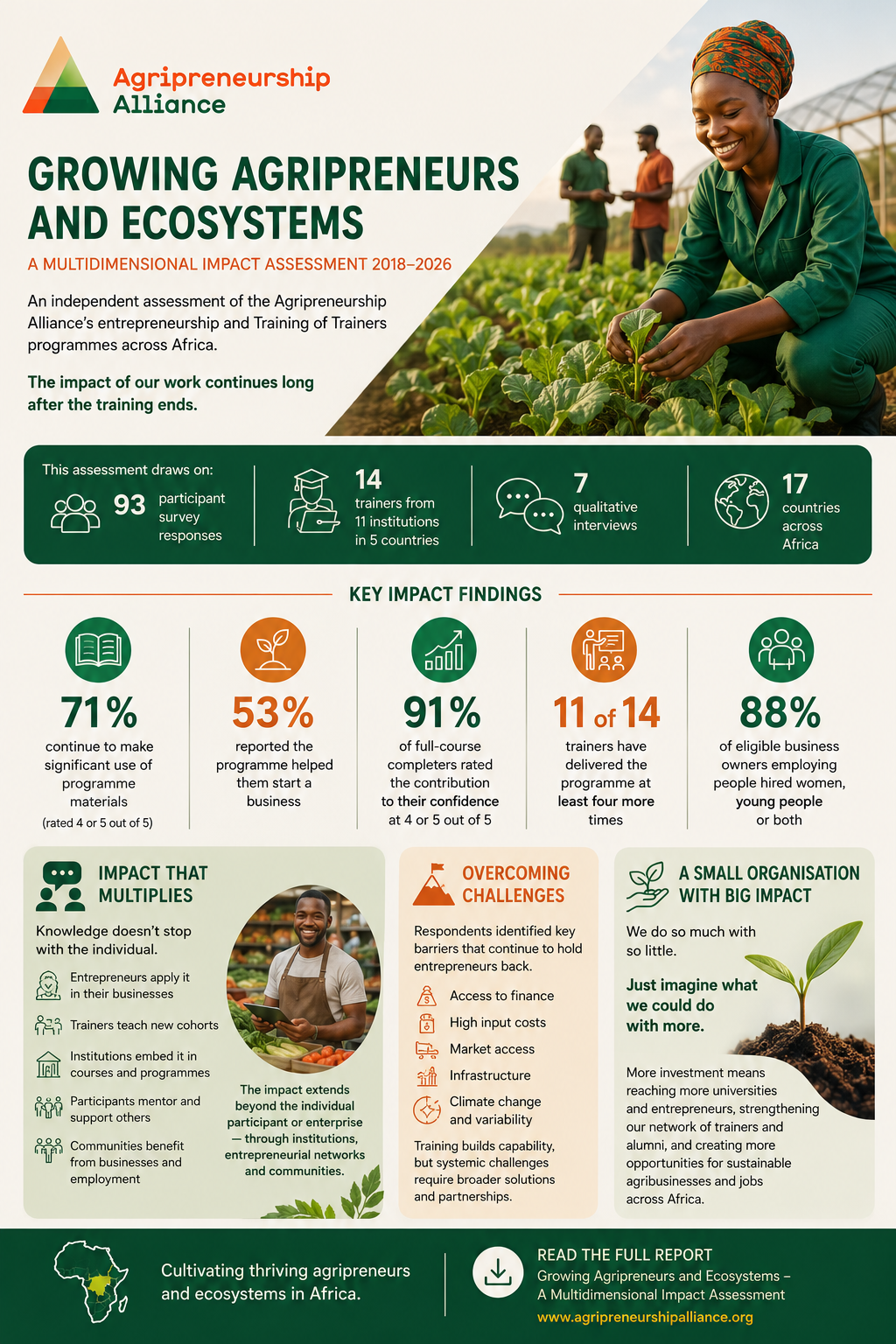
The question, therefore, was not simply "Did AAAM cause this?" but rather: what lasting contribution has our work made to participants, businesses, trainers, institutions and the wider agripreneurship ecosystem?The study draws on 93 cleaned participant survey responses from 17 countries, 14 trainers representing 11 institutions across five countries, and seven qualitative interviews. It also openly acknowledges the limitations inherent in a retrospective, self-selecting survey and does not claim that its respondents are representative of every person reached by the Alliance since 2018.
What did we find?
The results provide encouraging evidence that the value of the programmes continues well beyond the original training.71% of respondents rated their continued use of programme materials at 4 or 5 out of 5. Among those completing the full course, this rose to 78%. Participants described continuing to use the materials for business planning, financial management, marketing and decision-making.53% reported that the programme had helped them start a business, while 34% said it had helped them expand an existing enterprise. Respondents also reported gaining customers and markets, improving products and services, increasing sales or revenue, formalising businesses and creating employment.Confidence was particularly striking. Among respondents who completed the full course, 91% rated the programme's contribution to their confidence in starting, managing or growing an agribusiness at 4 or 5 out of 5.But perhaps some of the most important findings concern what happens when knowledge begins to multiply.
All 14 Training of Trainers respondents had subsequently delivered Entrepreneurship in Agribusiness training themselves, and 11 had delivered it at least four times. Alliance materials are now being used in university courses, youth programmes, farmer training, short courses, online learning and business incubation. Thirteen of the 14 trainers rated the programme's contribution to their institution's capacity to support agripreneurship at 4 or 5 out of 5.The effects extend further still. Participants reported mentoring other entrepreneurs, sharing business knowledge, supporting farmer groups and cooperatives, and creating opportunities within their communities. Among eligible respondents operating businesses and employing workers, 88% employed women, young people or both. Respondents also identified wider contributions to food security, agricultural practices and local economic activity.
Capacity that remains
Perhaps the most important conclusion of the research is that the Alliance's impact cannot be understood simply by counting the people we train.Knowledge continues to circulate.An entrepreneur applies it to a business. A lecturer incorporates it into a university course. A trained participant mentors another entrepreneur. A trainer teaches another cohort. A business employs a young person. An institution strengthens its entrepreneurship provision. And some of those reached go on to teach and support others themselves.As Anas concludes, the evidence points towards an impact that extends "beyond the individual participant or enterprise", through institutions, entrepreneurial networks and communities.
There are also important constraints. Around seven in ten respondents identified access to finance as a major challenge, alongside input costs, market access, infrastructure and climate pressures. Training cannot remove these structural barriers. But the evidence suggests that it can give entrepreneurs and the institutions supporting them greater capacity to navigate them.
Doing more with more
The Agripreneurship Alliance has always been a small organisation with limited resources. We work through partnerships, build local capacity and try to ensure that the knowledge and tools we develop remain useful long after a particular project or funding cycle has ended.
This research provides evidence that this approach works.It also leaves us with an exciting question.If this is what a small organisation can achieve with relatively modest resources, imagine what we could achieve with more.More investment would allow us to reach more universities and entrepreneurs, strengthen our growing network of trainers and alumni, expand access to our programmes across languages and countries, and connect more promising agripreneurs with the finance, markets and support they need to turn capability into sustainable businesses and employment.
The potential is already there. Our task now is to help it grow.
Download the full report: Growing Agripreneurs and Ecosystems – A Multidimensional Impact Assessment